1. Slope Deformation Processes on the South Massif
Recent tectonism and the long-lasting effects of subsurface geometry in Taurus-Littrow Valley, Apollo 17 landing site
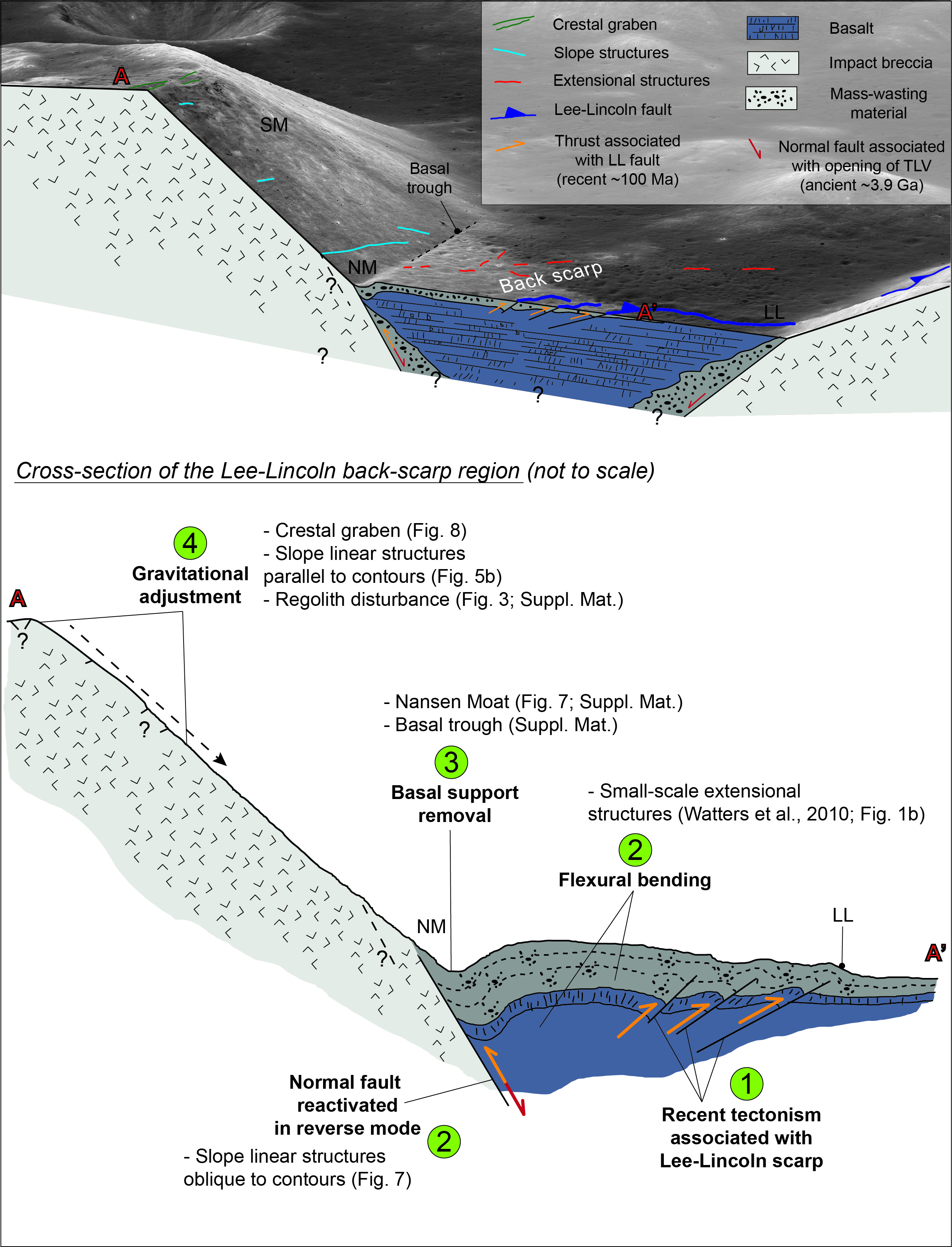
The South Massif and Taurus-Littrow Valley represent a unique setting for understanding recent geological processes on the Moon. Two overlapping landslide deposits and boulder falls indicate that repetitive instability has affected the north-east facing slope of the South Massif. The young Lee-Lincoln lobate scarp, associated with a thrust fault, suggests seismic shaking may have been an important trigger for surface changes and mass-wasting events in the area.
In this work, we use the younger landslide deposit — the Light Mantle — as a geomorphological marker. It is the only known extraterrestrial landslide with an absolute age constraint (70–110 Myr), provided by the Apollo 17 returned samples, making it a valuable time marker for surface changes that occurred since its emplacement.
We identify a variety of features on the NE slope of the South Massif that record recent slope deformation: boulder tracks, disturbed regolith, breaks in slope, crestal graben, and other linear slope structures. The pervasive nature of this deformation evidence suggests repetitive processes have effectively reshaped these slopes — driven by the ongoing effects of recent tectonism along the Lee-Lincoln fault, coupled with subsurface geometry inherited from the original impact basin formation.

2. Distal Rays and Secondary Craters of the Tycho Impact Event Revealed Through Deep Learning.
This work is in review in JGR-Planets