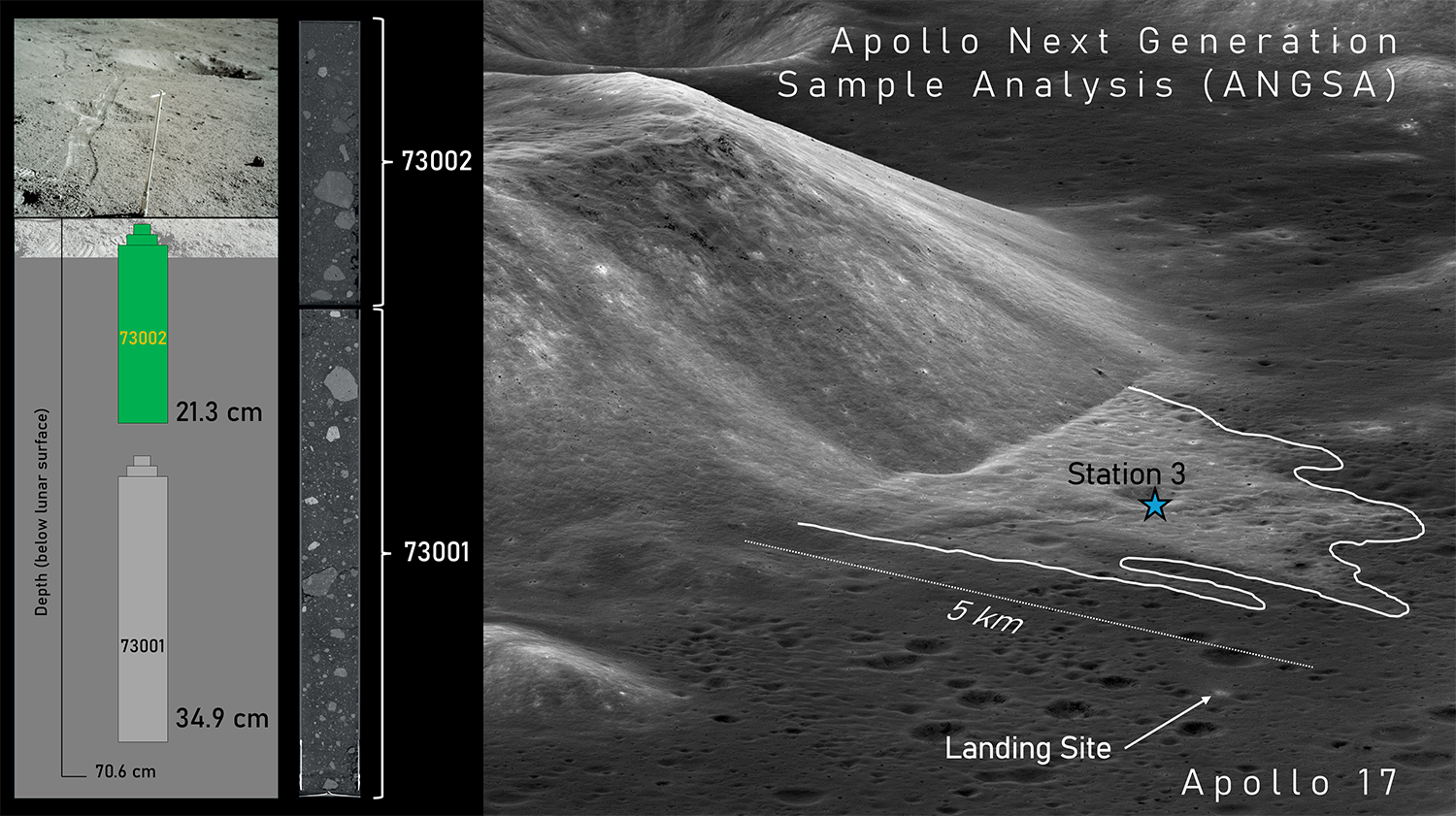
1. 3D and 2D Clast Analysis of Apollo 17 Core Sample 73002: Insights into Light Mantle Dynamics and Regolith Reworking
The Apollo 17 double drive tube 73001/73002
The recently opened Apollo 17 double drive tube 73002/73001 provides a new set of samples to investigate the origin and emplacement mechanisms of the Light Mantle. Prior to dissection, the double drive tube was scanned using X-ray computed tomography (XCT), producing a high-resolution digital 3D dataset at 12.9 μm per voxel — one of the hallmark "next generation" capabilities now available to researchers.
This dataset enables novel interrogation approaches and new insights into lunar material and processes. Critically, it also preserves the full 3D spatial context of all subsamples extracted from the original core, ensuring that material removed for destructive analysis can still be situated within the broader stratigraphic record.
XCT scans and thin section analysis of the upper 20 cm
In this study, we combine high-resolution XCT scans with high-resolution scans of thin sections from the upper 20 cm of the core — sample 73002 — to characterise clast fabrics, morphologies, and spatial distributions within the deposit. This dual 3D and 2D approach allows us to cross-validate observations across scales and analytical methods, yielding new constraints on the emplacement dynamics of the Light Mantle and the subsequent reworking of the regolith.